+40 749 680 770Monday - Sunday: 10:00 - 18:00
RomânăDeutschEnglish
Turist in Transilvania
HomeAccommodationToursDiscover Transylvania
Turist in Transilvania
HomeAccommodationToursDiscover Transylvania
+40 749 680 770
Turist in Transilvania

Discover the beauty of Transylvania - from medieval fortresses to spectacular mountain landscapes.

+40 749 680 770
contact@turistintransilvania.com

Menu

  • Home
  • Discover
  • Accommodations
  • Tours

About Us

  • About Us
  • FAQ
  • Terms and Conditions
  • Privacy Policy
  • Cookie Policy

Accommodation

  • Medieval Apartments Frauendorf
  • Burg Apartments Meschen
  • Unesco Apartments Wurmloch

© 2026 Turist în Transilvania. All rights reserved.

RomânăDeutschEnglish
Boian, the place where time seems to stand guard.
FestivalsTraditionHistoryCustomsTourist areasMediașSibiuOthersHartibaciu Valley

Boian, the place where time seems to stand guard.

Tudor-Dan Ravoiu
•December 18, 2012

Boian: A Village in Sibiu County

Boian is a village located in the northwestern part of Sibiu County, in the Tarnava Plateau. It belongs to the commune of Bazna. The locality is complemented by the Boian Valley, nestled among high hills that surround it on three sides: east, west, and south. The highest elevation is the "Droze" hill, whose eastern slope descends into the Rorii Valley, which separates the borders of Boian from those of Bazna. To the north, the built-up area is bordered by the Bălţii Valley, known as Muhle Grabben in the 18th century and Unt Aue in 1875.

Documentary Certification

703 years ago, the Saxon priest Theodoric of villa Boneti refused to pay the 10% tax to the Chapter of Alba Iulia, just like the majority of priests from the surrounding villages. This fact is recorded in the documents of the trial that took place, marking the first documentary mention of the village of Boian. It happened in the year 1309, in the month of July, on the 3rd, the date the trial concluded.

The Old Names of the Settlement

The settlement of Boian has had various names over time:

  • Initially called Villa Boneti.
  • Formerly known as Boianu de Jos and Bazna de Jos.
  • In Saxon dialect: Bonnesdref.
  • In German: Bonnesdorf, Bonisdorf, Bunnesdorf, Boneschdorf, Unter-Bassen, Unter-Bossern.
  • In Hungarian: Alsóbajom.

It seems that the first representative of the Romanians from Boian is recorded in the year 1344 under the name Nicolaus de Bayum, meaning *Nicolae from Boian*.

The Current Appearance of the Locality

Boian has the appearance of a composite village, with its central axis oriented in a north-south direction, deviating a few degrees to the west. The Main Street, shaped like a shuttle, is closed at both ends with islands connected to the main street by narrower and winding streets.

The Homestead

Due to the depopulation of the village, the households are largely disorganized today. In fact, while the homes still withstand abandonment, the outbuildings were the first structures to physically suffer from the village's abandonment, especially by the younger generation.

The Elements of the Household

  • The water fountain.
  • The large barn, both in plan and volume.
  • The shed built on an oak frame housed tools and firewood.
  • The grain dryer.
  • The pigsty.

What You Can See in Boian

  1. The Saxon Church - The fortified Lutheran church dates back to the 14th - 15th centuries, but the first documentary mention is from 1309.
  2. The Orthodox Church "Annunciation" - The Orthodox church dedicated to "Saint Archangels Michael and Gabriel" was built between 1904-1908 on the site of another Orthodox church that was demolished.
  3. The Greek-Catholic Church - The re-establishment of the Boian Parish after the 1989 revolution took place in 1996, under the direct care of Pr. Mons. George Surdu, former rector of the Greek-Catholic Mission in Paris, a son of the village of Boian.
  4. The general school with grades I-VIII in Boian.
  5. The cultural center in the locality.

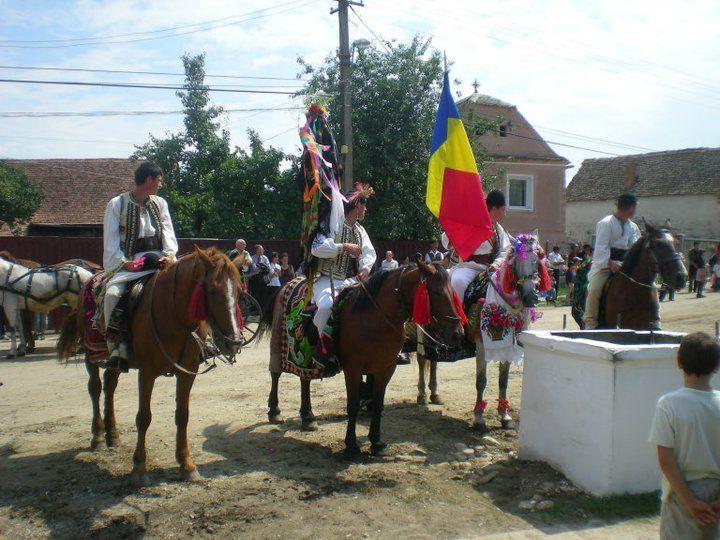
On the occasion of the documentary attestation in 2009, marking 700 years of the locality of Boian, the decision was made to establish the Association of the Sons of the Village of Boian. This village celebration is usually held on the last Sunday of July.

Article submitted and written by Ioan Muntean, a son of the village of Boian. You can send your texts to contact@turistintransilvania.com

Photo credit: Ioan Muntean
Share this article

Articles

Related Articles

Transylvanian Brunch at Bunești - 2026 Edition: A Sensory Experience in the Heart of Transylvania
Festivals

Transylvanian Brunch at Bunești - 2026 Edition: A Sensory Experience in the Heart of Transylvania

Transylvanian Brunch at Bunești - 2026 Edition: A Sensory Experience in the Heart of Transylvania Starting from April 4th, the Transylvanian Brunch event o...

March 11, 2026readMore
The Restoration Camp at Bánffy Castle in Bonțida: A Unique Experience in Saving Heritage
Festivals

The Restoration Camp at Bánffy Castle in Bonțida: A Unique Experience in Saving Heritage

The Restoration Camp at Bánffy Castle in Bonțida: A Unique Experience in Saving Heritage In the heart of Transylvania, in the locality of Bonțida, Cluj Cou...

March 10, 2026readMore
Barockada - Old Music in Alba Carolina Citadel
Festivals

Barockada - Old Music in Alba Carolina Citadel

Barockada - Old Music in Alba Carolina Citadel In the heart of Transylvania, in Alba Iulia, a cultural event of exception is being prepared: Barockada, an ...

March 9, 2026readMore
All articles