+40 749 680 770Monday - Sunday: 10:00 - 18:00

Mălâncrav / Malmkrog / Almakerek is an idyllic, picturesque village nestled among hills, approximately equidistant from Biertan and Sighișoara. A dreamlike place that holds many secrets within its walls, which is why the Mihai Eminescu Trust, under the patronage of Prince Charles, has established itself in Mălâncrav. The fortified church, with its unique 14th-century frescoes, is under the protection of national historical monuments. Right next to the church stands, in an unusual combination, the lovingly restored manor of the noble Hungarian Apafi family, who owned the church and the village.
However, the greatest mystery lies hidden in the church's altar!
The 15th-century altar is a donation from the Apafi family and is dedicated to the Virgin Mary. Unusually, the construction of the altar is such that most of its kind are designed to open and close like a cupboard depending on the feast day. But in Mălâncrav, it is different because when the altar is opened, two additional outer wings can also be opened from the sides, which are not visible in its normal state.
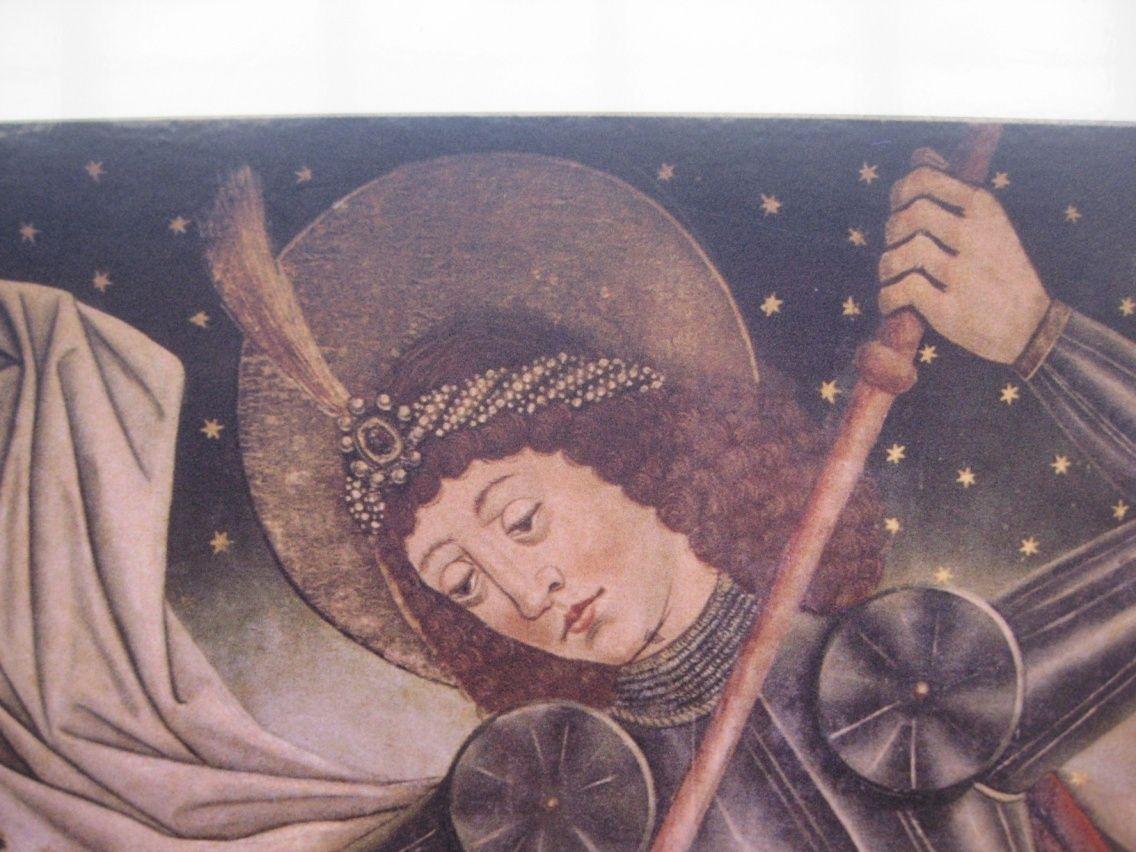
But it is precisely these two hidden wings of the altar that form the unusual pair with a unique representation: they depict the two "Dragon Hunters" of the Christian faith, with Archangel Michael on the left and Saint George on the right.
But that's not all! With a closer look at the head of Saint George, you can observe a diadem. It is made up of strands of pearls and dark-colored beads, held together by a brooch at the center, which features a ruby surrounded by 10 pearls and a feather at the top.
Such an identical jewel was worn on the head by only one other person in history – Vlad III, better known as Vlad the Impaler or *Dracula*! He usually also wore a cap, but these pictures show Vlad the Impaler as the "young" version:
Can the young Vlad III be presented as a dragon hunter on the altar in Mălâncrav?
The young Vlad III was not seen as "Țepeș," that is clear. Until his death in 1476, he signed himself as Wladislaus Dragwlya or Ladislau Dragkulya. His father, Vlad II, a son of the great ruler Mircea the Elder, brought this "noble name" into the family after being appointed in 1431 in Nuremberg as a knight of the Order of the Dragon.
The founder of the order was Sigismund of Luxembourg, who in 1431, along with Vlad II, traveled to Rome to be crowned emperor. Sigismund had held the Order of the Dragon since 1408, when he was merely the king of Hungary and Croatia. The members were all male relatives of the Apafi family, as well as Vlad III's grandfather, the great voivode of Wallachia, Mircea the Elder, and Vlad II's son.
Many of these genealogical branches, especially concerning the mothers and wives of Vlad II and Vlad III, as well as the Apafi family, remain shrouded in mystery.
Could the Apafi family from Mălâncrav have been close relatives of the Draculești? Would this explain why Vlad II chose Sighișoara as a refuge and minted coins here? Could the two Dragon Hunters on the altar in Mălâncrav be Vlad II and his son Vlad Țepeș? It would be a portrait of perspective: father and son, defenders of the multi-ethnic freedom of Romanians, Hungarians, and Saxons...
 Festivals
Exile and homeland – in Ovid's footsteps through Romania (from Transylvania to the Black Sea) (Guided individual trip with minibus/HP) Contact person: Ladislau Ciocan / Dr. Heike Lammers-Harlander Travel companion: Ladislau Ciocan / Dr. Heike...
 History
Hunedoara County is a truly impressive and marvelous area. Being quite large in size, it encompasses several municipalities, including Deva – which, moreover, is considered the county's capital. The county is made up of Deva, Sântuhalm, and the...
 Adventure
In 1964, the commune of Teliciu Inferior was documented by the State Council. This settlement holds vital importance for the entire Hunedoara County, as well as for the village of Cinciș. We will see later why. The area around the village of Cinciș...