+40 749 680 770Monday - Sunday: 10:00 - 18:00

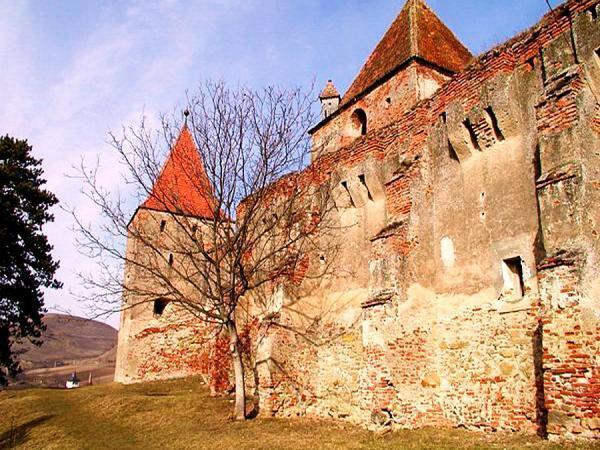
On your way from Sibiu to Mediaș, 18 kilometers from Sibiu, a sign appears indicating that there is a village in the area with a history full of myths and legends still discussed today – Slimnic. This small locality is home to the ruins of an imposing fortress from the past, also known as the northern border security point of the Saxon Seat of Sibiu.
Built as early as the 14th century, the fortress is the home of many legends, whether embodied or even experienced. Their truthfulness, however, remains at the discretion of each visitor. Words from ancient ancestors testify that many strange things have happened in these lands, things that deserve a review.
The first legend, published in 1908 in *Schäßburger Zeitung, refers to a wizard*, the father of three daughters with magical powers. Each of them was to build a fortress according to her own wishes:
The second legend that circulates in the area says that during the siege of the Kurucs, a tunnel was used through which the soldiers defending the fortress received food from a chapel in the Saxon cemetery. These supplies were sent via a coffin in a funeral ritual mimicked by the villagers, and once delivered to the destination, at night the men would cross the tunnel and take the food.
The legend concludes with the sharing of the secret by a local woman who, it is said, fell in love with a Kuruc soldier, causing the soldiers to run out of supplies and be defeated.
The fortress also hosts a Reconciliation Room, as couples wishing to divorce at that time were kept there until they decided not to go through with it. Thus, in Slimnic, over 200 years, only 2 divorces were recorded, with the other marriages being saved.
The Proud Fortress rightly deserves its name, as it has been conquered, besieged, and partially reconstructed over a span of 6 centuries. As a side note, the ruins we see today are due to the plague epidemic transmitted from local to local, which is why the only attempts at renovation and restoration during those times were abruptly halted and resumed only in 1959.
When you are nearby, don’t hesitate to visit the beautiful structure – if you are lucky, you might meet the inhabitants who are said to still dwell in the fortress.
 Tourist areas
The Residences of the Hungarian Nobility in Transylvania - An Exceptional Destination in Attractive Romania Transylvania, a historical region of Romania, i...
 Tourist areas
Polovragi Resort: A Model of Sustainable and Ecological Tourism in the Heart of Transylvania In the heart of Transylvania, at the intersection of mountains...
 Tourist areas
Romania - Spectacular Accommodations Romania, our country, is known for its natural and historical beauties, offering a wide range of accommodation options...