+40 749 680 770Monday - Sunday: 10:00 - 18:00

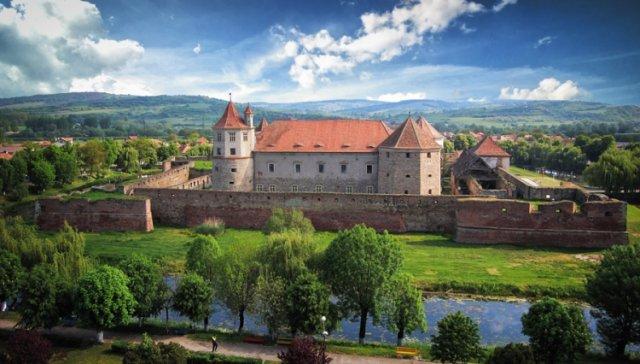
Located in the center of the country and in the heart of Făgăraș, Făgăraș Fortress dates back to the 14th century, specifically the year 1310, when the construction of the fortress began. It was only later, in the 18th century, that the fortress was completed, with its four centuries of history being influenced by political and decision-making changes.
Originally designed from a strategic standpoint, the Făgăraș Fortress defended the southwest of Transylvania from Tartars and Ottomans. Somewhere around 1526, Ștefan Mailat decided to upgrade the fortress, transforming it into a true fortification. Later, in 1599, the fortress came into the hands of Michael the Brave, who decided to gift it to his wife, Lady Stanca.
The bust statue still exists near the Făgăraș fortress, a monument that signals that a legend is still present in the depths of the fortification, maintaining its mystery. And it’s no wonder. In the 18th century, under Austrian rule, the fortress became a garrison and even a prison.
Only later, between 1948 and 1960, the fortress was transformed into a prison for opponents of the communist system, a sort of camp for political prisoners from the Făgăraș region, specifically a prison within the Romanian Gulag system. Even today, these rooms, which not long ago were the torture chambers of our ancestors, can still be visited.
An interesting aspect to bring up is the legend. Făgăraș Fortress maintains its prestige and rank among the top 3 most beautiful castles in Europe through the legend that keeps its mystery alive. It is said that for many years, a renowned torture device known as the "Iron Maiden" was located here.
The mechanism was so impressive and so well designed that the strategy always bore fruit. Thus, the one who was condemned was not beheaded – but rather took his own life through his own actions. He would kiss an icon of the Virgin Mary on the chest of a statue, as this simple touch triggered a mechanism that caused the condemned's body to be pierced by daggers.
Given that the entire process unfolded in the blink of an eye, as soon as the daggers were drawn, a trapdoor would open through which the body, already transformed into a corpse, would fall and be torn apart by some blades. The last journey of the unfortunate soul ended 8 meters below, in the waters of the Olt River, destined to cleanse the castle of the offerings made.
Although the legend is horrifically terrifying, the Făgăraș Fortress is worth a visit, and if you are in the area, you absolutely must see the prisons. Something tells me you'll have that opportunity very soon, given that all roads lead to the heart of the country, namely Făgăraș!
 Tourist areas
The Transylvania Amphitheater: A Dream Refuge in the Heart of the Carpathians In the village of Moieciu de Sus, Brașov County, there is a magical place whe...
 Tourist areas
Sighisoara Citadel: A Treasure of History and Beauty in the Heart of Transylvania Sighisoara Citadel, located in Mures County, in the heart of historical T...
 Tourist areas
Haferland - The Land of Oats, a Dream Region in the Heart of Transylvania In the heart of Transylvania, between Brașov and Mureș, lies one of the most pict...