+40 749 680 770Monday - Sunday: 10:00 - 18:00

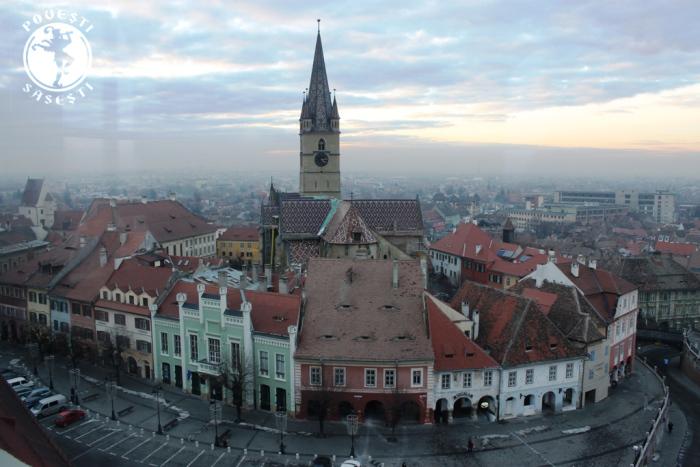
In the heart of Sibiu stands the distinctive Council Tower. It is the best starting point for anyone wishing to explore the historical landmarks of Sibiu on foot. Known as *Turnul Sfatului in Romanian, it is the city's emblem, ancient yet not lacking in architectural elegance. It serves as the link between the Little and the Great Ring*, a cosmic axis that has been intimately woven into the life of the people of Sibiu for centuries. Once you have climbed to the top of the tower, the view downwards is breathtaking: an oasis of urban beauty unfolds at your feet.
Today, the Council Tower is regarded only as a historical monument, but its history dates back to the years 1224-1241 – serving as an access gate to the city's second fortification belt. In its immediate vicinity was the meeting place of the city councilors, from which the tower also derived its name.
However, only a part of the original tower's foundation walls has survived up to the first floor, as its external appearance changed over many years. After a devastating earthquake in 1588, it was decided to add additional stories above the original four. This was not the end of its transformation: time and again, extensive renovations and expansions reshaped the structure.
As a direct testimony to the oldest layer of settlement in Sibiu, the Council Tower bridges the various epochs of the city with its changing administrative, military, and cultural functions.
The list of its tasks is long:
From the very beginning, the Council Tower has also stood as a silent witness to history, watching over the rooftops of the city with keen eyes.
It observed the bustling trade in the marketplaces as well as citizens' assemblies; at some point between the world wars, a Zeppelin floated above it, and once, the tram of Hermannstadt wound its way along its walls. Many sought rest in its shadow – nobility and cruel conquerors alike, busy locals, as well as tourist bohemians and tame pigeons.
If anyone could share the secrets of Hermannstadt, it would be the Council Tower: it would tell of the events that unfolded in the two squares at its feet – from medieval executions to the concerts and festivals of our time. And it could confirm: the dynamic Hermannstadt grew and continues to grow from its multicultural heritage – and is always full of surprises!
One enters the tower through a narrow gate, accessible via the Small Ring. On the penultimate floor, the sophisticated mechanism of the tower clock ticks in harmony with the rhythm of footsteps on the Great Ring. From the very top, the tower watches over the city in all four directions, safeguarding it from harm in the future.
Text: Heike Lammers
 Festivals
Exile and homeland – in Ovid's footsteps through Romania (from Transylvania to the Black Sea) (Guided individual trip with minibus/HP) Contact person: Ladislau Ciocan / Dr. Heike Lammers-Harlander Travel companion: Ladislau Ciocan / Dr. Heike...
 History
Hunedoara County is a truly impressive and marvelous area. Being quite large in size, it encompasses several municipalities, including Deva – which, moreover, is considered the county's capital. The county is made up of Deva, Sântuhalm, and the...
 Adventure
In 1964, the commune of Teliciu Inferior was documented by the State Council. This settlement holds vital importance for the entire Hunedoara County, as well as for the village of Cinciș. We will see later why. The area around the village of Cinciș...