+40 749 680 770Monday - Sunday: 10:00 - 18:00

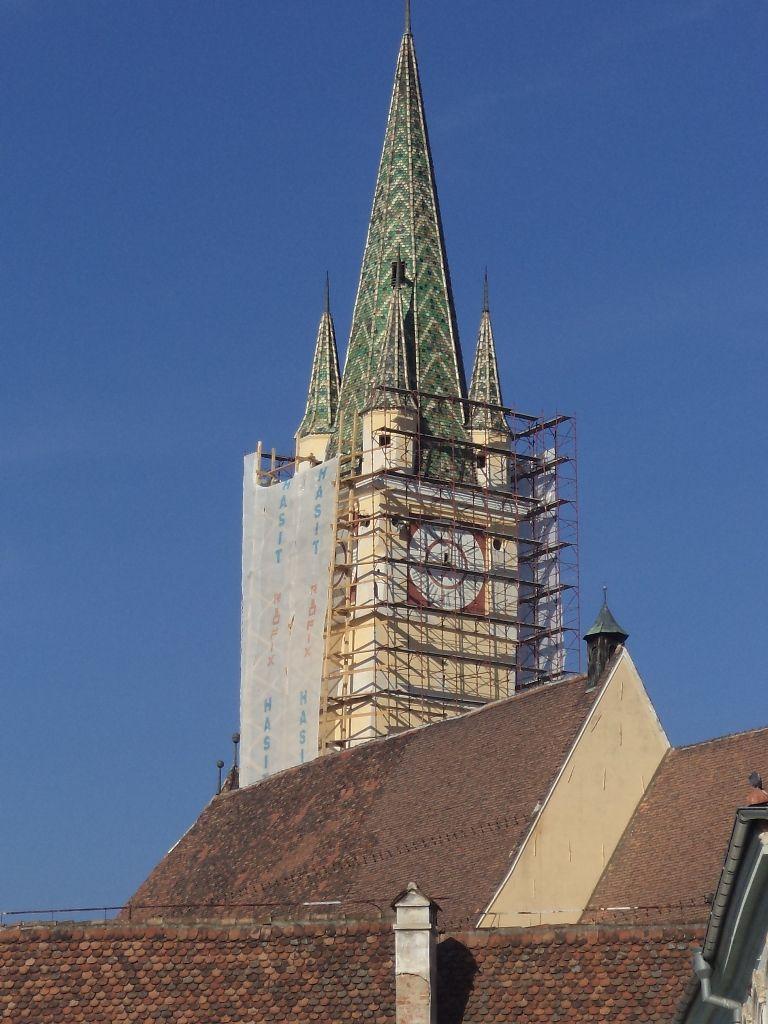
From Mediaș, we receive the news that the project for the renovation of the Trumpeter Tower has begun, for which many residents of Mediaș have donated following a joint appeal from the Evangelical Church community and HG Mediaș. This is a good opportunity to reflect on the history and the changing fortunes of the tower.
A contribution by Johann Auner from 1925 in the Mediaș newspaper sheds light on the origin of its name (see also the contribution on page xy in this issue):
"Trumpeter Tower: The Trumpeter Tower is the landmark of our city. When a Mediaș resident is abroad and longs for home, he first and foremost thinks of his Trumpeter Tower, which has captured his heart. 'Tramit' means trumpet, which was originally nothing more than a straight tube, slightly widened at the front. The roof of the Trumpeter Tower resembles an inverted trumpet. Later, 'Tramit' became 'Tramiter' and 'trumpet' became 'trumpeter'; thus, the names Tramiter Tower and Trumpeter Tower emerged, which is fundamentally incorrect and should actually be Tramiten Tower and Trumpeten Tower. About 100 years ago, lightning struck the tower. Now the roof has been repaired, a lightning rod installed, and a new tower knob placed on top. An image of the latter can be found on the north side of the church wall, to the left of the entrance, towards the parsonage. The carpenters carried the knob from house to house to earn a tip, and people placed their children on it so they could later say they had also sat on the tower knob. That's how it was told to me. And when the knob was set in place and the lightning rod secured, the carpenter sat on the tower knob, took off and put on his shoes to prove his steadiness, and drank a bottle of wine. He threw the bottle and the glass into Badergasse, and both arrived—unbelievably but true—unscathed. They must have fallen softly! Of course, this was still at a time when wild ducks were shot in the old pond, where the railway embankment now runs, and when the wine-laden carts got stuck in the marsh in St. L. Rothgasse; hence the name Kotgasse."
How old the tower is can no longer be determined. It is first mentioned in a document in 1508. Its original height corresponded to about the lower five floors of the current tower; it served as a bell tower. The traces of the bell frame were identified during the renovation work in the 1920s.
For over 450 years now, it has watched over our hometown at its current height and has long become its landmark. Although the Mediaș residents may have been secretly accused of undue pride, it certainly also had a practical use.
Although the tower soon leaned dangerously on the uneven ground after the addition of the lower predecessor, it withstood all storms and all misfortunes that the forces of nature brought upon it.
Time and again, however, the citizens of the town had to lend a hand and carry out repairs on the tower. On such occasions, documents were placed in two of the tower knobs, testifying to the connection of the townspeople with their tower.
The Mediaș newspaper reported extensively on the content of the documents in September 1927.
Today, as the Mediaș church community prepares to renovate the Tramiter Tower once again, we want to give voice to the tower guard of the year 1783. At that time, Stephanus Schnell wrote a document, which he...
 Festivals
Transilvania Bike Trails Race 2026: A Cycling and Heritage Discovery Experience In the heart of rural Transylvania, from August 19-23, 2026, one of the mos...
 Festivals
Transylvania Bike Trails Race Festival 2026: A Complete Vacation Experience in the Heart of Transylvania From August 19-23, 2026, the Hills of Transylvania...
 Festivals
The Village of Țapu (Abtsdorf): An Oasis of Peace and Tradition in the Heart of Transylvanian Hills Located in Sibiu County, in the commune of Micăsasa, Th...