+40 749 680 770Monday - Sunday: 10:00 - 18:00

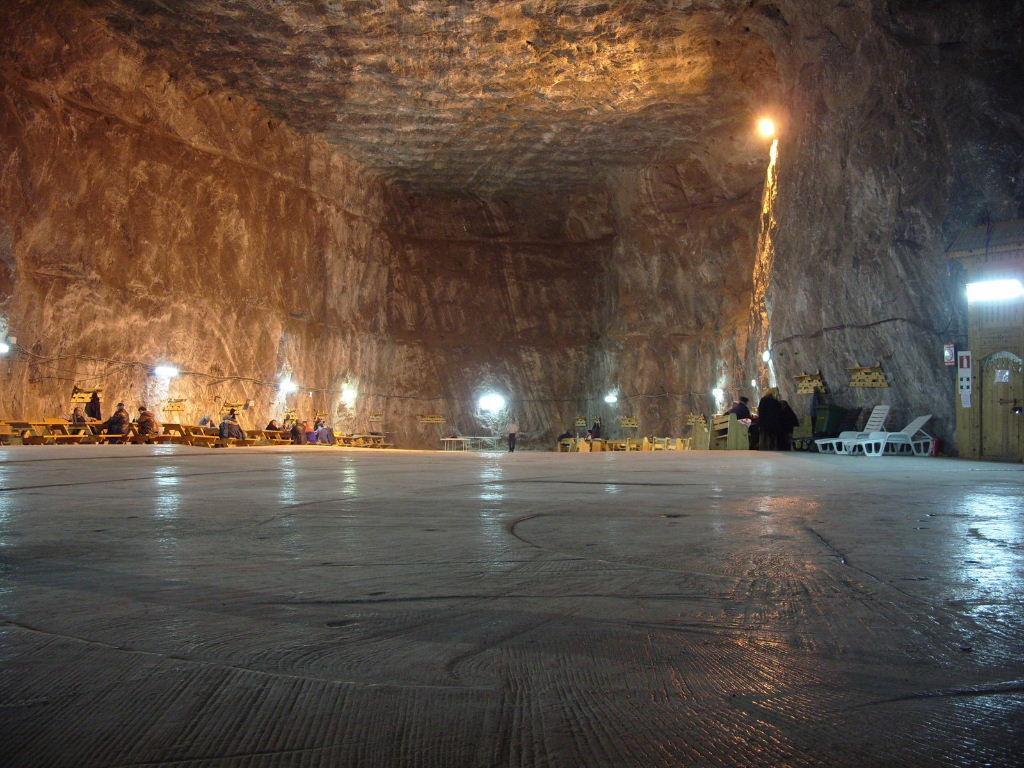
Praid Salt Mine is a rock salt mine in Romania, located in Harghita County. The mine is situated in the Gurghiu Mountains basin, encompassed within the Salt Hill, forming the triangle Praid - Ocna de Jos - Ocna de Sus.
The salt deposits in Transylvania (systematically exploited over time at Ocna Dejului, Sic, Cojocna, Turda, Ocna Mureș, Ocna Sibiului, and Praid) were formed 13.5 million years ago, in a shallow sea under a very warm tropical climate. The respective geological layer corresponds to the middle Miocene.
The salt body at Praid has a slightly elliptical shape in horizontal plan, with diameters of 1.2 and 1.4 km, and based on exploration boreholes (S ACEX 401/1949 and S 110/1973), it is estimated to have a depth of 2.6 - 2.8 km, making it the largest diapirogen rock salt body in the country.
The first salt exploitations are documented from Roman times, but the mine in Praid is first mentioned in documents from 1200, with intensive exploitation starting in 1700.
Volker Wollmann, in his monograph on mining, emphasizes the presence of a Roman fortification near the salt deposits each time. The Roman fort Praetoria Augusta at Inlăceni protected the salt exploitations at Praid.
In 1980, a treatment facility was opened in the salt mine. Following the extraction of salt, large underground cavities were formed, where a salt mine microclimate was established, with:
The air is highly ionized, particularly effective in treating respiratory conditions.
The treatment facility, located at "horizon 50," at a depth of 120 m, has:
Over a distance of 1250 m from the entrance of the mine to the treatment facility, transportation for visitors is provided by the mine's buses.
The mine is equipped with:
At Praid Salt Mine, underground speleo- and climatotherapy treatments are conducted as a simple and effective method for:
In 2009, Praid Salt Mine was the most visited salt mine in Romania, with over 200,000 tourists annually, followed by Slănic Prahova with over 150,000 tourists, and Târgu Ocna and Cacica Salt Mines.
Source: [Wikipedia](http://ro.wikipedia.org)
 Tourist areas
The Transylvania Amphitheater: A Dream Refuge in the Heart of the Carpathians In the village of Moieciu de Sus, Brașov County, there is a magical place whe...
 Tourist areas
Sighisoara Citadel: A Treasure of History and Beauty in the Heart of Transylvania Sighisoara Citadel, located in Mures County, in the heart of historical T...
 Tourist areas
Haferland - The Land of Oats, a Dream Region in the Heart of Transylvania In the heart of Transylvania, between Brașov and Mureș, lies one of the most pict...