+40 749 680 770Monday - Sunday: 10:00 - 18:00

The authors of the text are: Julie Dawson, Project Director *Researching the Archives of Transylvania and Bukovina (Leo Baeck Institute), Letiția Cosnean, architect, and Anda Reuben*, project manager.
The city of Mediaș was founded by Saxon settlers in the 12th century. By the mid-19th century, there were already many Jewish families in the surrounding villages, with a few even residing in Mediaș. After the revolution of 1848 and the subsequent easing of residency restrictions, many Jewish families from the countryside gradually moved to Mediaș, thus laying the foundations of the community in Mediaș.
Around this time, David Bäumel from Wolfersdorf, Bohemia, arrived in the region. He became the first rabbi of the community and married Lotte Kappel, the daughter of a wealthy family that had lived in Mediaș since the late 18th century. By the early 20th century, the community was well-established and had built a new and imposing synagogue on the outskirts of the medieval city walls. Officially, the community spoke German, in accordance with the Saxon majority of the population.
David Bäumel passed away in 1899, and in 1905, a new rabbi, Moishe Reich from Budapest, took on rabbinical responsibilities. In the 1920s, the community president, Benjamin Czitron, financed the construction of a Jewish school and a ritual bath, *mikva*, alongside the synagogue.
The community survived World War II with relatively few losses; however, at the end of the war, a series of significant changes occurred within the community:
Like many Jews in Romania, in the 1950s and 1960s, the majority of the Jews here emigrated to Israel and other countries.
With the fall of communism at the end of the '80s, only a handful of people remained. Today, the synagogue is empty, and the archival documents and prayer books are housed in the former administrative building next to the synagogue.
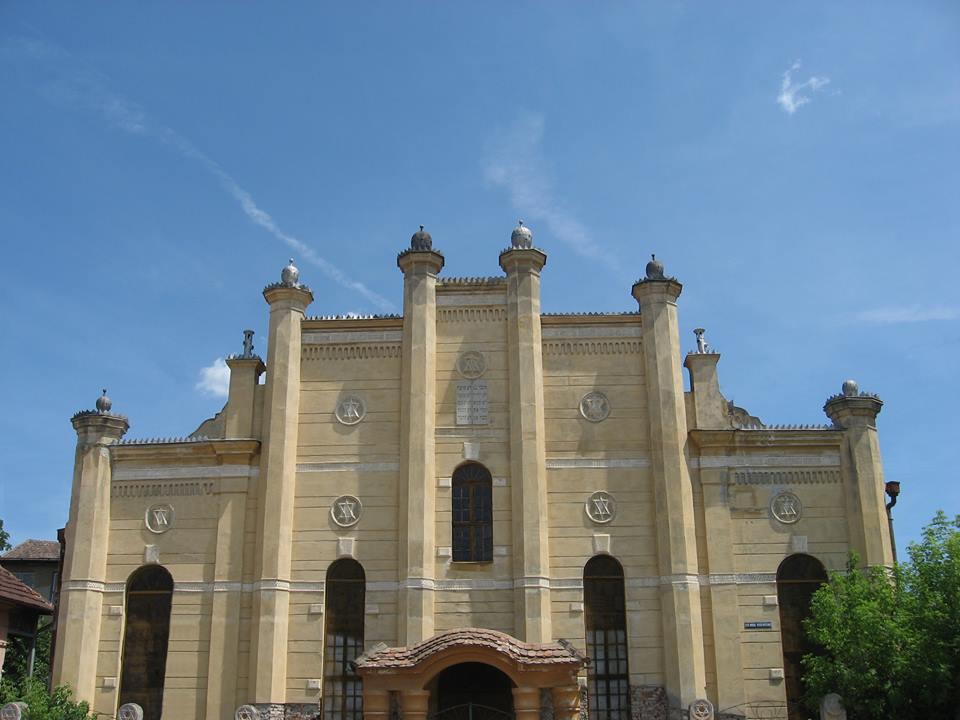
The building was constructed in 1896, with some modifications made over the years, such as the two side rooms on either side of the vestibule. Behind the synagogue are the school and the ritual bath, *mikva*.
The architecture of the synagogues in Transylvania was influenced by the late 19th-century style of the Austro-Hungarian Empire. The style of the synagogue in Mediaș is 19th-century eclecticism, with a strong romantic and Moorish influence:
It is very likely that the architect of this synagogue drew inspiration from the architecture seen in Vienna and Budapest and adapted it to the needs of the community and the regional architecture.
The interior space is divided into two areas: the entrance area and the ceremony hall. The entrance area is divided into three rooms located on the west side. The room to the right of the entrance was dedicated to the study of the Torah, while on the left is the staircase leading to the women's balcony.
The ceremony hall is generously sized – 18X11 meters and is framed on three sides by the women's balcony. In the middle of the nave stands a platform, called the bimah, decorated with carved wooden elements and surrounded by benches. This is where the Torah scrolls were brought to be read to the congregation. When not in use during religious ceremonies, the Torah scrolls were kept in a cabinet called the ark, located on a platform on the eastern wall, facing the direction of Jerusalem. Above the ark are the two tablets of the law, with the Ten Commandments.
The murals are artistic representations of traditional elements: the menorah, lions, the Star of David, the Ten Commandments, the fortress of Jerusalem, and various plant elements.
In 2008, a large number of documents, books, and objects belonging to the Jewish community of Mediaș were discovered inside the synagogue. The oldest documents date back to the end of the 19th century, with many from the interwar and post-war periods.
From May 2014 to April 2015, a project is underway aimed at cataloging and digitizing this archive. The donor who financed this project wished to remain anonymous. The project's activities are supported by the Mihai Eminescu Trust Foundation (www.mihaieminescutrust.org). The digitized materials will be available online thanks to the Leo Baeck Institute (lbi.org) in New York, USA, which is conducting a long-term study of archival materials related to the history of Jews in Transylvania and Bukovina (jbat.lbi.org).
 Tourist areas
The Transylvania Amphitheater: A Dream Refuge in the Heart of the Carpathians In the village of Moieciu de Sus, Brașov County, there is a magical place whe...
 Tourist areas
Sighisoara Citadel: A Treasure of History and Beauty in the Heart of Transylvania Sighisoara Citadel, located in Mures County, in the heart of historical T...
 Tourist areas
Haferland - The Land of Oats, a Dream Region in the Heart of Transylvania In the heart of Transylvania, between Brașov and Mureș, lies one of the most pict...