Easter Traditions and Customs in Transylvania
Easter Traditions in Transylvania
The Easter celebration has its specific traditions and customs in Transylvania due to the confluence of Eastern and Western influences.
Over time, this holiday has adopted specific traditions from the Saxons, Hungarians, and Romanians.
Preparations for Easter
On Wednesday, Thursday, and Good Friday, women prepare the *pasca* (Easter bread), lamb, and eggs, which are distinguished in this area by a wide variety of patterns and colors.
Saturday Customs
On Saturday:
- Boys decorate fir trees with colorful ribbons.
- In the evening, young people sneak into the yards of unmarried girls and hang the trees at their gates.
Easter Table Rituals
At the Easter table, the red eggs are cracked according to a specific ritual:
- The elder person (usually the man) taps the head of the egg held in the hand of a family member while saying, "Christ has risen!"
- The response is, "Indeed, He has risen!"
First Day of Easter
On the first day of Easter, in some Transylvanian villages:
- All members wash their faces in the morning with water in which a red egg, a silver coin, and a sprig of basil have been placed.
- There is a belief that you will have good fortune all year if the first person to enter the house is a man.
The lunch on the first day of Easter is an occasion for family reunion, and the table must include:
- Red eggs
- Green onions
- Sheep cheese
- Salad
- Radishes
- Lamb drob (a type of meatloaf)
- Roasted lamb
Second Day of Easter
On the second day of Easter:
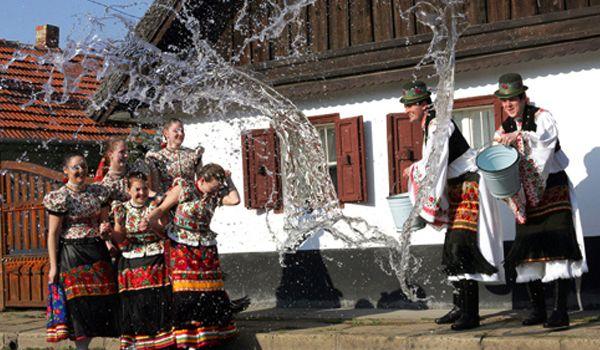
- Young girls and women are sprinkled with perfume by young men and men dressed in traditional clothing.
- The girls, in turn, offer the boys drinks, red eggs, and cake.
relatedPosts
FestivalsRomania Trip
Romania and the Danube-Ries – what connects us... (Private guided tour by minibus/half board) Contact person: Ladislau Ciocan / Dr. Heike Lammers-Harlander Travel companion: Ladislau Ciocan / Dr. Heike Lammers-Harlander / Victor...
CuisineGrandma's Cellar - The Flavor of Transylvania
The beautiful landscape denotes the remarkable survival of Medieval Europe - a mosaic of ancient forests, meadows, and pastures rich in wildflowers, along with ancient villages featuring fortified Saxon churches. Traditional agricultural methods are...
FestivalsThe meeting of the Medias Saxons in Dinkelsbühl was a success.
The meeting of the Medias Saxons in Dinkelsbühl, Germany, began on Friday, June 14, 2013, with over 300 participants gathering in the "Schranne" hall to celebrate together. Saturday was dominated by the theme: - The German school system in...