+40 749 680 770Monday - Sunday: 10:00 - 18:00

(Private guided tour by minibus/half board)
or Focşani – Mărăşeşti – Piatra Neamţ
or Piatra Neamţ – Bicaz Gorge – Praid – Sângeorgiu de Pădure – Călimăneşti - Mediaş
Where war begins, humanity has failed. The bloody battles of World War I, with millions of dead, destruction, hardship, and misery plunged all of Europe into agony. The image of the trenches in Verdun, where opposing soldiers killed each other senselessly, is particularly etched in memory. Under this impression, it is often forgotten that World War I was also fought with extreme brutality on other front lines. In 2016, we commemorate the hundredth anniversary of Romania's forced entry into the war on the side of...
against the
As a "countermeasure," Bavarian and Austrian troops were quickly assembled along the newly established front line. What followed was a series of bloody victories and heavy losses on both sides. Statistics refer to them as collateral damage: the fates of countless individuals on both sides who either survived this inferno or found death within it...
The journey organized by the Historical Association for Donauwörth and Surroundings takes you to many places that became battlefields for countless soldiers from the Donau-Ries region. It provides information about the front line, allows participants from both sides to share their stories, and offers relatives of the Donauwörther and Donau-Ries soldiers who fought or fell at this front the opportunity to visit these sites—often far from the typical "tourist" routes.
But what would such a trip be without the thought of reconciliation and a shared European future? Accordingly, the journey also leads to destinations that authentically represent the country of Romania and its people. History and religion, culture and nature, culinary experiences, and not least the direct contact with the residents of this hospitable country make the trip an unforgettable experience.
Welcome! Heartfelt welcome!
(1300 km + 218 km)
Either arrival by plane or by bus to the meeting point in Sibiu (Hermannstadt). From here – in and around Hermannstadt, the first major Romanian attack took place in 1916 – the route leads through the heavily contested Red Tower Pass during World War I, along the important points of Boiţa and Lazaret, passing by a Roman watchtower and the Cozia Monastery. Our first stop is at the Turnu Monastery, idyllically located by the Olt River. From here, we head to the reconstructed Roman fort Arutela, before continuing through Râmnicu Vâlcea to Caracal – the former ancient Romula (“Little Rome”). Upon arrival, we will check into the Primavera Hotel for three nights. After dinner, a short lecture will introduce the upcoming days.
(102 km)
After breakfast, we will walk with our knowledgeable guide, Dr. Sabin Popovici, to the old town of Caracal (approximately 1 hour). Among the sights are the former municipal synagogue and the Romanian War Heroes Monument from World War I. The route also passes by the building that housed the German Command during the occupation (1917-1918). The tour concludes with a visit to the Muzeul Romanaţiului, which offers us an initial insight into the southern Romanian region north of the Danube, from the Neolithic period to the 20th century.
From the museum, we will take a bus to the Jewish cemetery (including the Tahara house) on the outskirts of Caracal: here you will learn more about the Jewish communities in Romania and rituals in *Judaism. Afterwards, we will continue along the old Roman road, passing the military base Deveselu (the site of the American/NATO missile defense system) with a huge "time leap" into the Neolithic. In Vădastriţa (35 km), we will visit a pottery that specializes in the reconstruction and reproduction of Neolithic artifacts: The replicas vividly illustrate life within one of the most significant Neolithic cultures in the Danube region, whose main center (under and next to the present-day village of Vădastriţa) gave the place and the entire culture its name: Vădastra*.
To recharge, we will take a break for lunch in Corabia (23 km), right by the Danube. Then, a short walk through the museum in Corabia is on the agenda, which informs about the history of the Danube town. From here, it’s just a "stone's throw" to the former Roman fort Sucidava, located directly on the Danube, beside whose walls once stretched the largest bridge over the Danube. The fort complex is currently undergoing extensive renovation and will be opened to the public for the first time in summer 2016! Back in Caracal, you will have the rest of the day to explore the city on your own.
(190 km)
On this day, we dive deep into Romanian history and culture. After breakfast, we take the bus to Drăgăneşti, located about 25 km away, always along the route that the German troops took during World War I towards Bucharest. Here, we cross the Olt River (just like the soldiers did a hundred years ago). However, our day's objectives are particularly focused on fostering understanding among nations! In Drăgăneşti, we visit the open-air museum, where typical house forms of the country (including the earth house) are showcased. In the accompanying museum building, you can view exhibits on Romania's experiences during World War I.
Afterwards, our route takes us to Spătaru, where a cozy farmhouse with a garden awaits us with a traditional local welcome. From here, we head to the nearby Seaca, where we will switch to horse-drawn carts to travel the last three kilometers through the forest into an idyllic valley to our next destination: the former Seaca Muşeteşti Monastery. The seclusion of this small complex makes it easy to feel transported back to the founding period (around 1500, perhaps even earlier) of the oldest monastery in the Olt region. Here, we will receive an introduction to the Orthodox religious life of Romania. Of course, you are also free to let the unique atmosphere of this place wash over you.
Then, we make our way back to Caracal, where the day (and our journey through Oltenia) concludes with a festive dinner: Ofelia Popovici will musically guide us through the evening with traditional Romanian folk music, accompanied by culinary delights from the country.
(376 km)
After an early morning breakfast, we leave Oltenia and the Danube Plain and set off towards the Carpathians. Our first destination after 178 km is the old capital of Wallachia, from where the Voivodes (including Vlad III. Draculea "Ţepeş") ruled the land. The place gained sad notoriety when Romania's ex-dictator Nicolae Ceauşescu and his wife Elena were executed there by a brief tribunal on December 25, 1989. However, we will visit the old princely court and learn more about Ţara Românească, which has always had to protect the outer borders of Europe under difficult conditions.
The further journey takes us through the areas that were fiercely contested during World War I, resulting in bloody losses on both sides. After 155 km to Targovişte, we will make our way to Racoviteni, where in 1917 a huge mausoleum, including a soldiers' cemetery, was built by Bavarian troops for their fallen comrades. Today, the secluded giant complex is just a ruin, but no place is better suited to reflect on the events of the Romanian front line and to commemorate the fallen on both sides. Then we continue to Focşani (57 km), where dinner and our hotel await us.
or
Two routes are now possible, as the journey is specifically designed to offer the opportunity for relatives of former war participants to accompany them to places of interest. Both routes begin in Focşani, where we will visit the city after breakfast, one of the former headquarters of the Central Powers, and learn more about its significance during the war, as well as during the period of German-Austrian occupation. Next, we will head to Mărăşeşti (23 km) to one of the largest memorial sites of the First World War from the Romanian side. Here, too, we will gather after visiting the site to honor the memory of the victims on both sides.
After that, two routes could be envisioned:
This route leads through the Carpathians to Brașov (Kronstadt) (181 km). It follows the front line of the war's beginning into the Transylvanian Burzenland, towards the fortified city of Kronstadt. After a walking tour through the old town of Brașov, the day ends at a hotel in Zărnești (29 km).
The route runs along the southern side of the Carpathians to Piatra Neamţ (Kreuzburg on the Bistrita) and follows the course of the battle during the mid-war period, where many positional battles took place. After a tour of Piatra Neamţ, the day concludes at a hotel on-site.
The route leads from Zărneşti to the Törzpass (9 km), also a site of battles during World War I. Over its entrance looms Bran Castle, which is always marketed to tourists as "Dracula's Castle." Even though Vlad III. Draculea likely never set foot in this fortress, it is interesting enough as a Hohenzollern castle in Romania to be worthy of a visit. Perhaps you will even decide spontaneously to buy the castle, which is up for sale?
After "Dracula's Castle," the journey continues along the traces of World War I through the "Ghost Forest" and the northern foothills of the Carpathians to the ruins of Rupea Castle (Reps) (90 km), which has been renovated in recent years. Here, you will taste Transylvanian spirits in the donjon. Refreshed, you will continue on to Mediaş (Mediasch) (93 km), where you can unwind after a cozy dinner at your accommodation.
This trip takes you along the former front line through the Carpathians into the spectacular nature of the Bicaz Gorge, leading to Lacul Roşu (Red Lake) (61 km), where we will make a stop that you can happily round off with delicious Mici. We then continue into the Transylvanian Szekler region to Praid (Parajd/Salt Mine) (76 km): Here, you will have the opportunity to visit the unique Praid Salt Mine (please remember to bring a jacket and suitable footwear!), which dates back to the Middle Ages.
So much salt makes you thirsty! That’s why we head to Călimăneşti (Kelementelke) (39 km), where a tasting of Szekler wines and specialties awaits you in a former manor house. But first, we will make a stop to visit the birth castle and burial church of the great-great-grandmother of the British Queen in Sângeorgiu de Pădure (Erdöszentgyörgy) (7 km). Refreshed, we will make our way to the Transylvanian Mediaş (Mediasch) (56 km), where dinner and overnight accommodation await us.
(142 km)
This day is dedicated to the history and culture of Transylvania, which has been home to the German-speaking Transylvanian Saxons for over 800 years. After a brief tour of Mediaș, we drive to Sighișoara (Schäßburg) (39 km) and visit the old town, including the Church on the Hill and the so-called "Dracula's Birthplace." While the house may not be very authentic, it is always suitable for a photo, but be sure to take a closer look at the Church on the Hill! Can you find the emblem of the Order of the Dragon, which gave Dracula, his father, and their family branch its name? From one mystery to the next!
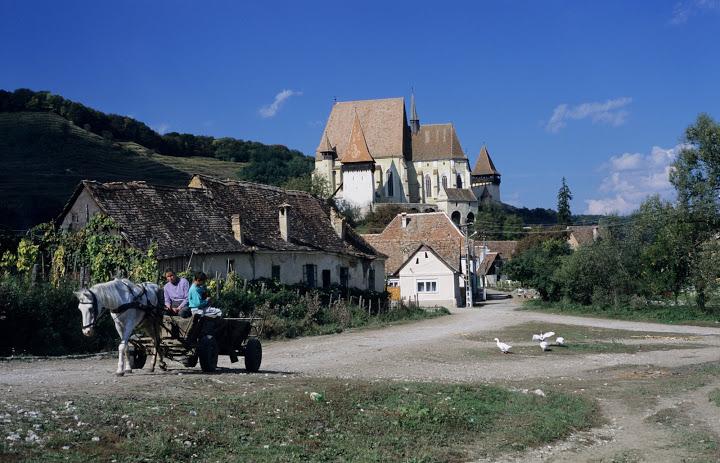
The journey continues to two former estates of the Hungarian noble family Apafy, Dumbrăveni (Elisabethstadt/Erzsébetváros) (21 km) and Mălâncrav (Malmkrog/Almakerek) (22 km): Prepare to be surprised! After Mălâncrav, whose castle and church were the first objects supported by the Mihai Eminescu Trust, you can gear up for a visit to the most important fortified church in Transylvania, the former bishopric of Biertan (Birthälm) (31 km). There, after lunch, you will learn more about the religious life of the Transylvanian Saxons.
From here, we continue to Moșna (Meschen) (19 km), where the everyday life of the Saxon population and their traditions are on the agenda. Here, you will also have the chance to taste local Transylvanian specialties. After a fulfilling day, we return to Mediaș (10 km).
+ 1300 km
What would a stay in Transylvania be without a visit to Sibiu (Hermannstadt) (55km)? Therefore, on the last day of our trip, we leave Mediaș after breakfast to allow ample time for an extensive city tour through the historic center of Hermannstadt. Be impressed by the squares, churches, alleys, and streets of the city, and enjoy the full culinary offerings one last time before we embark on our journey home.
Have a great trip!
The journey will take you to places that are not "touristically developed," but have managed to preserve their authenticity. This also means that you may have to forgo some of the usual comforts at times and should not be apprehensive about experiencing traditional ways of life (e.g., outdoor toilets, poor road conditions, walking paths). It's worth it!
Subject to change!
 Festivals
The Development of Tourism in Romania 2026 Conference: A Reference Event in the Heart of Transylvania On November 26-27, 2026, Cluj-Napoca, one of the most...
 Festivals
Șona, Alba County: A Saxon Village with Authentic Rural Charm Șona, a Saxon village located in Alba County, on the banks of the Little Târnava, is a settle...
 Festivals
LA PAS Festival 2026: A Weekend Celebration of Clean Food and Sustainability in Timișoara Between October 9-11, 2026, Timișoara will host the LA PAS Festiv...